Career Advice for Job Seekers
Why AI Security Should Be the Next Essential Skill for Future Technology Professionals

By Dr. Sruthi Balammagari, PhD
There is a high probability of new vulnerabilities, which can be introduced by AI systems, like manipulation in models, prompt injection, and leakage of data. There is a high value in professionals who understand both AI and security, and I believe there is already a curriculum for AI in the universities, but you would hardly find courses that teach AI security, and I believe the next generation of engineers should learn how to secure AI systems.
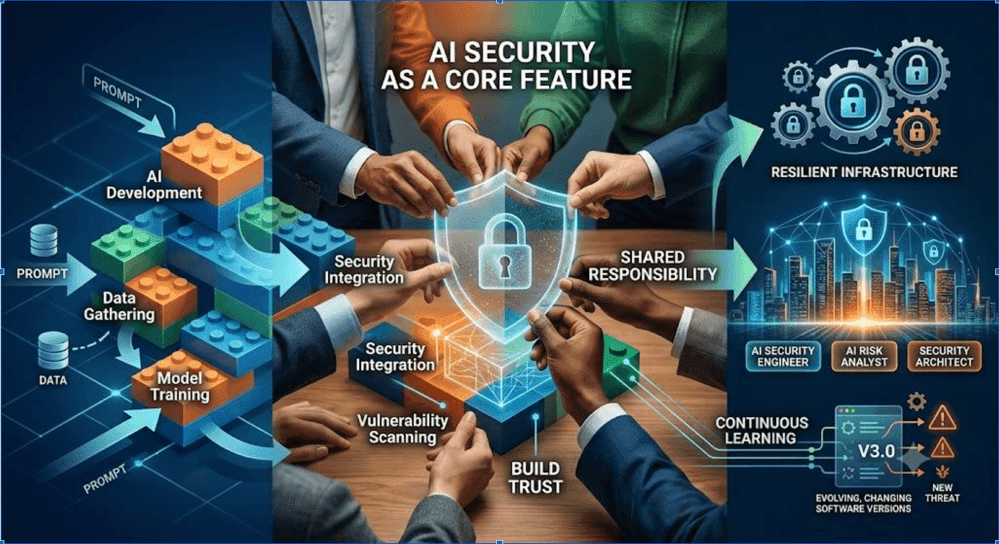
Security has to be a part of the developmental lifecycle, and that can be achieved only when developers learn to build systems that secure APIs and the data associated with them. I also believe AI should not alone be the responsibility of the cybersecurity engineers. It must be the primary responsibility of the students to not only concentrate on the AI tools but also make sure security is part of them. There are many possible career paths, like AI security engineer, AI risk analyst, security architect, ML security engineer, etc. I feel the adoption of AI by more people is solely dependent on the trust factor, and all the future tech leaders should be treating security as a core feature and not something that can be thought about in the future after the systems are built.
Security teams have been spending many years to help employees to build strong security guidelines, but with AI, there is a whole new kind of risk emerging where engineers have started building AI agents that can now access systems with maximum control. Cybersecurity is the number one IT skill right now, whereas data security ranks second, and the reason this is happening is because of the widespread adoption of AI tools. Organizations are in a race of deploying agentic workflows, pipelines, and autonomous systems that make work efficient, so security has become a shared responsibility for everyone and not just the security team alone. A single failure can ripple through everything connected in an AI system; as if one model goes offline or starts producing malicious outputs, every tool or service built on top of it can be affected, slowing the entire workflow or even causing complete system shutdowns.
AI systems must be considered unpredictable, goal-driven taskmasters that require continuous behavioral validation, action-level controls, and supervision rather than static security rules that can be outdated. As AI systems introduce new failure into the workflows, we have to make sure we understand the end-to-end system, like how the data is collected and how models are trained and deployed. We should also understand how systems are interacting with humans, and the whole security journey lies in connecting all these dots. Most of the AI security failures occur at the boundaries, and we have to make sure we don’t fall prey to such attacks. We’re seeing phishing emails and voice deepfakes, which are so real and convincing that anybody could believe them, and there is so much adaptability where attackers can quickly adjust to the patterns and create thousands of personalized versions, which can be faster, cheaper, and easier to create.
A Three-Tier AI Security Framework
Tier 1: This tier focuses on getting an understanding of basic security, and I would recommend everyone to go through IBM’s Cybersecurity Essentials, which is a very crucial document that will help you identify fundamentals on how to recognize and mitigate potential risks. The goal here is to bring awareness in employees on what is suspicious and what is not and understand the basics of secure data handling.
Tier 2: Tier 2 belongs to developers and software engineers, where they have to have an in-depth understanding of security issues around LLMs and agentic systems. Information Privacy ranks as the top GenAI skill. For data professionals, priority areas include data privacy regulations for AI systems and identifying risks in training data.
Tier 3: This tier comprises security specialists who need special training in anything around AI and adversarial testing of AI applications. The teams should conduct red-teaming exercises and build resilient defenses against AI-specific attack vectors.
A Roadmap to Becoming an AI Security Expert
This would provide a clear roadmap on how to become a solid AI security expert in a short span of time, where you would focus on the basics of Python, which is a core language for both AI and ML security tooling. You should be in a stage where you will be able to read and write comfortably. Then switch to the machine learning basics, where you understand how to train models, training data, and how models fail. You will have to understand what the systems you will be attacking and defending are. You also have to be familiar with the security fundamentals like authentication, access control, common vulnerabilities, and the CIA Triad. Then you would jump into AI security, which would be treated as a core feature.
You would focus on adversarial machine learning, LLM security, and AI threat modeling. Then after that you would focus on specialized areas like RAG systems, agentic AI security, secure training data, and CI/CD for machine learning against supply chain attacks and studying unsafe autonomous actions. You would then spend some time on acquiring hands-on certifications like Certified AI Security Professional (CAISP) and building a portfolio on breaking AI models in the environment and fixing them. Some of the AI security tools that you can use are Garak, an open-source LLM scanner that can catch any kind of vulnerability and helps focus on prompt injection, jailbreaks, data leakage, etc. Then comes the Python risk identification tool, a.k.a. PyRIT, which was developed by Microsoft and which automates red teaming so that you can test multiple attacks at once. You would also concentrate on tools like MITRE ATLAS, which is a bible of real-world attacks on AI systems.
Industries like finance, defense tech, and healthcare generally hire AI security engineers most actively, as these sectors handle confidential data and critical infrastructure, so they need people who can protect AI systems for any kind of misuse.
Why Future Engineers Need AI Security Skills
Future engineers are in a dire need of developing a skill set needed to improve their AI security knowledge, as attacks like prompt injection, where the attackers can manipulate an LLM to behave as they want to, could lead to compromised access issues and data breaches. Even though people are heavily relying on AI outputs, the trust factor is not 100%, as these outputs, when entering any system without validation, can cause vulnerabilities that can be hard to notice, which could also lead to exposing sensitive information. AI security should be a part of an engineer’s skill set, as building systems without knowing these risks could lead to unintentional threats. The next generation of technology professionals are not expected to just build AI systems but systems that can be trusted.
For future professionals and current students, a skill set with various disciplines can be built where learning Python can provide a great foundation for working with AI and security tools. Developing a good understanding of machine learning basics can help professionals build models and understand how they are trained and how they can fail and be attacked. Cybersecurity fundamentals are very much necessary to understand how authentication, authorization, and access control are built into a secure system. They can also focus on AI-specific areas such as LLM security, adversarial machine learning, RAG security, agentic AI, threat modeling, and AI supply-chain risks. They should also focus on gaining hands-on experience in AI security, as learning theories will not be enough. They should be focusing on how to identify vulnerabilities in applications, gain knowledge on red-teaming frameworks, and prevent such vulnerabilities in the future by means of a mitigation plan. The goal should be developing a mindset that will continuously question the AI systems on how they would fail and how the attacker would find ways to attack or manipulate the system and develop proper risk mitigation controls to eradicate them.
The AI threat landscape is changing at an alarming rate, where new models and agentic systems are merging rapidly. A professional who learns AI security now cannot rely on having sufficient knowledge five years from now, as future technology is changing very quickly, and to keep up the pace, we should be in continuous learning mode as AI capabilities and threats evolve. AI security should be a combination of human awareness and technical knowledge, and this would happen only when AI systems and humans work together.
Industry standards must be created in this way. The deployment of AI systems and AI security go hand in hand, rather than being viewed because of application deployment. The projects should begin with questions like how data can be protected by providing the right access controls, model behavior, and any kind of potential misuse, and this is also a very affordable option where you build security into the AI application from the beginning rather than attempting to add it later after the issues have been discovered. Professionals who develop expertise in vacuous areas like IA, cybersecurity, software engineering, and cloud architecture will have a huge demand in the market as organizations focus on people who can innovate while managing risk.
Article courtesy of Dr. Sruthi Balammagari, PhD, a full stack developer with Comcast with expertise in cybersecurity and AI.
New Job Postings
Advanced Search
